The Trees of Southwest Florida: A Simple Naples Guide to the Beautiful, the Native, and the Not-So-Welcome…
As a Naples real estate professional, I spend a lot of time looking at homes from the perspective of a buyer…not just the neighborhood, the floor plan and finishes, but the things that can affect how a property feels and functions over time. Landscaping is one of those details that is easy to overlook when you’re falling in love with a house. But, to me, sometimes the trees are part of the magic…and sometimes the reason someone buys one house over another when narrowing down selections. I can call to mind several closings where the buyers told me, “It was that beautiful Live Oak tree that sealed it for us…”
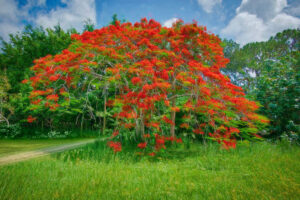
If you live in Naples, you probably have a favorite tree. I’m a “tree-hugger” from way back…What is your favorite Naples tree? Maybe it’s the enormous live oak shading an old neighborhood street. Maybe it’s a royal poinciana exploding with red-orange flowers in the summer. Maybe it’s a graceful palm beside a pool, a flowering tabebuia lining a driveway, or the unmistakable smooth and shiny coppery-red bark of a gumbo limbo.
One of the things that makes Southwest Florida so beautiful is our extraordinary variety of trees and tropical plants.
But here’s something every Naples homeowner — and especially every prospective homebuyer — should know:
Not every beautiful tree is a good tree for your property.
Some trees are native treasures. Some are spectacular flowering ornamentals. Some become enormous and need plenty of room. Others can create problems with roots, debris, maintenance or storm damage. And a few non-native species can actually threaten Florida’s natural environment. So, before you plant that pretty tree, or before you fall in love with the landscaping around a Naples home, it helps to know what you’re looking at.
First: What Does “Native” Really Mean?
A native Florida tree is one that occurs naturally in Florida rather than having been introduced from somewhere else. But native doesn’t necessarily mean “best,” and non-native doesn’t necessarily mean “bad.” Florida landscapes contain many beautiful ornamental species that aren’t native but perform well here without becoming invasive. Native plants do, however, have some very important advantages. They evolved in our climate and can provide food and habitat for native wildlife. UF/IFAS [University of Florida Institute of Food and Agriculture Sciences] lists many familiar South Florida trees including live oak, cabbage palm, mahogany, bald cypress and gumbo limbo. as Florida natives. The key is choosing the right tree for the right place, and that’s particularly important in Naples, where a property might be waterfront, inland, on a golf course, in a preserve, or tucked into an established neighborhood.
Here are my Top Ten Trees to put on your radar when looking to buy a home or landscape your current property in Naples:
Gumbo Limbo — The Florida Original
If there were a tree that deserved to be called quintessential South Florida, gumbo limbo would be high on my list. Its smooth, peeling copper-colored bark gives it the nickname “tourist tree” — because it looks a little like someone who spent too much time in the Florida sun. It’s native to South Florida and is considered highly wind tolerant. It can eventually become a large tree, so give it room to grow.
Live Oak — Majestic and Timeless
The live oak is one of Florida’s great native trees. Its enormous spreading canopy can provide wonderful shade and create an established, almost estate-like feeling around a property. But there’s a catch: Live oaks need space. A mature oak is not something you want squeezed between your house, swimming pool, driveway and property line.
Mahogany — A Beautiful Shade Tree
West Indian mahogany is another South Florida native and is included by UF/IFAS among the staple native trees of South Florida. It’s attractive, evergreen and can make an impressive shade tree. Like many of the larger trees mentioned above, space matters, so don’t plant a future giant in a space designed for a small ornamental.
Cabbage Palm — The Real Florida Palm
The sabal palm, commonly called the cabbage palm, is Florida’s state tree. It’s native, unmistakably Floridian and generally much more at home in our landscape than many imported palms. If you want to plant a palm tree that definitely says, Florida”, this is it!
Buttonwood — Especially Good Near the Coast
Buttonwood is another South Florida native that can be particularly attractive in coastal landscapes. UF/IFAS includes it among native South Florida trees and notes its high salt tolerance. Planting it in yards closer to the coast is an ideal selection!
Geiger Tree — Flowers and Florida Personality
The native Geiger tree is a smaller ornamental tree with spectacular orange flowers. It can be especially attractive where you want color without committing to a massive canopy. This is a great colorful candidate for smaller yards!
Sea Grape — Coastal Beauty
Sea grape is another Florida native that belongs in the conversation when you’re talking about coastal Naples. Its large, rounded leaves and distinctive form give it a very tropical appearance. It can also tolerate coastal conditions well. Nothings says, “I live near the beach” better than a Sea Grape!
Bald Cypress — Gorgeous Around Water
Bald cypress is native to Florida and can work beautifully in landscapes with adequate moisture or around water features. However, UF/IFAS notes that it can do well both near water and on drier land. Beautiful and architectural — but make sure the location suits the mature tree. Personally, I only added this to the list because it is ‘native’ and I think they are so beautiful, but usually they do denote wetlands, and I have never actually heard of anyone planting one…Have you?
Tabebuia — Vibrant Flowering Tree
Now we’re getting into the trees that make people stop their cars. Tabebuia can put on an extraordinary flowering display, with pink, yellow or other colorful blooms depending on the species. It’s not a Florida native, but that doesn’t make it a bad landscape choice. For example, UF/IFAS lists pink trumpet tree as a non-native tree suitable for South Florida landscapes. This one is added to the list for its beauty. So, if you want a flowering tree that makes a statement, this is one to consider.
Royal Poinciana — The Showstopper
Few trees can compete with a royal poinciana in full bloom. Its broad canopy and brilliant flowers are spectacular. They are not red, they are not orange, they are a radiant coquelicot that demands your attention. But there is a very important however: This is a tree that needs room. A royal poinciana can become enormous and should be considered carefully before planting near a house, pool, driveway or property line. [Royal Poinciana Photo credit: Naples photographer Art David]
Southwest Florida gives homeowners an almost unfair number of choices when it comes to flowering trees. Depending on your property, you may also encounter: Jacaranda, Frangipani, Bottlebrush, Magnolia, and my personal favorite: the Hong Kong orchid tree! The important question isn’t simply “Is it pretty?” You also need to know, how big will it get? How much maintenance does it require? Does it drop flowers or fruit? How close will it be to the pool? How will it perform in our soil and exposure?
One of the wonderful things about buying a home in Naples is that the landscape can be part of the experience. A mature live oak. A canopy of palms. A flowering tabebuia. A dramatic royal poinciana. These aren’t just landscaping features. They’re part of what makes Southwest Florida feel like Southwest Florida. They are part of what makes a house a home.
So, the next time you’re walking through a Naples neighborhood, take a moment to look beyond the architecture. Look at the trees. They may tell you something important about the property — and about the place you’re thinking of calling home.
If you’re considering buying or selling a home in Naples, the NaplesRealEstate.com Team would be happy to help you look at the whole picture — including the view from the front yard to the tree canopy above it.
Thanks for following along! Happy Tree-hugging!
The Naples Real Estate Blogger